
10 Signs It's Time to Consider Home Care for Your Aging Parent
I've walked into a lot of homes over the years. Part of my work as a Medicaid assessor is sitting at someone's kitchen table, asking hard questions, and figuring out — sometimes in a single visit — how much help a family actually needs to stay safe and steady. And if there's one thing that's true almost every time, it's this: nobody calls right when they should. Families call weeks later. Sometimes months. Usually after something has already happened that could have been prevented, and usually with a version of the same sentence: “I wish we'd done this sooner.”
I understand why. Reaching out feels like admitting something is wrong, or like taking away a piece of your parent's independence, or like opening a door you're not sure you're ready to walk through. So instead, families wait. And I've sat with enough of them afterward to tell you honestly: waiting rarely makes the decision easier. It usually just means you make it later, under worse circumstances, with less time to think it through.
So here's what I actually look for, at that kitchen table — not to alarm you, but so you can recognize it on your own terms, before someone like me has to point it out after a fall or a hospital stay.
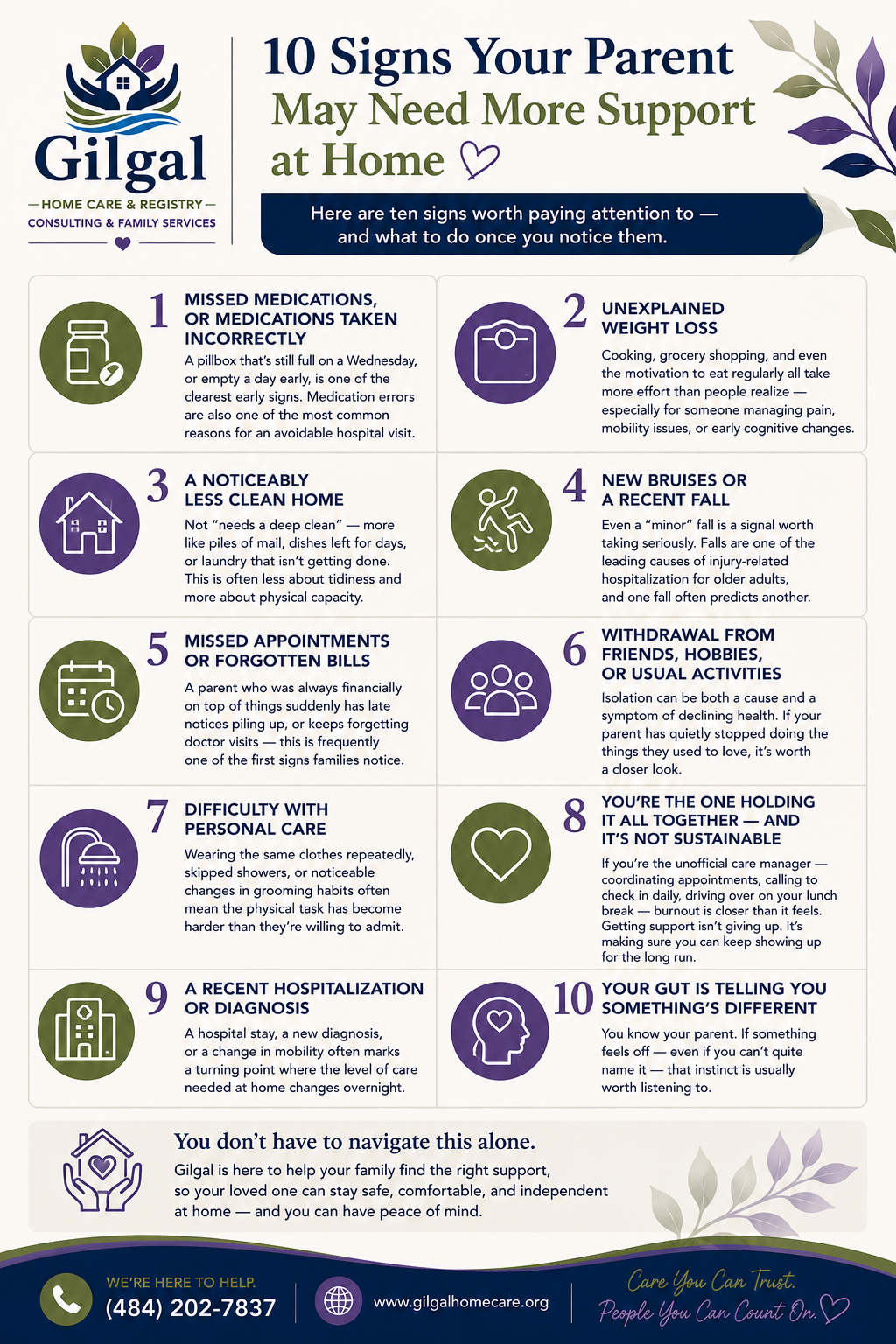
Missed medications, or medications taken incorrectly. A pillbox that's still full on a Wednesday, or empty a day early — I see this constantly, and it's one of the clearest early signs there is. Medication errors are one of the most common reasons for an entirely avoidable hospital visit.
Unexplained weight loss. People consistently underestimate how much effort cooking and eating regularly actually takes. I've walked into kitchens that looked completely untouched for weeks, and a parent who insists they're “eating fine.”
A noticeably less clean home. Not “needs a deep clean” — mail piling up, dishes sitting for days, laundry that doesn't get done. This is rarely about tidiness. It's almost always about what a body can still physically manage.
A recent fall, or new bruises. I take this one seriously every single time. Falls are one of the leading causes of hospitalization for older adults, and one fall is very often a preview of the next one.
Missed appointments or unpaid bills. A parent who was always sharp about money suddenly has late notices stacking up. This is frequently one of the very first things families notice, even before connecting it to anything bigger.
Withdrawal from friends, hobbies, or the things they used to love. Isolation can be a cause of decline and a symptom of it at the same time. If your parent has quietly stopped doing what used to genuinely light them up, it's worth a closer look.
Difficulty with personal care. The same clothes worn repeatedly, skipped showers, grooming that's noticeably slipped — this usually means the physical task itself has become harder than they're willing to admit out loud.
You're the one holding it all together. If you're the unofficial care manager — juggling appointments, calling daily, driving over on your lunch break — that pace is not sustainable. Getting support isn't giving up on your parent.
A recent hospitalization or new diagnosis. These moments often mark a real turning point, where the level of care needed at home shifts overnight rather than gradually, and families get caught off guard by how fast it happens.
Your gut is telling you something's different. You know your parent better than any assessment I could ever run in an hour-long visit. If something feels off, even if you can't name it yet, that instinct is worth trusting.
What to do if this sounds like your family
Recognizing these signs is genuinely the hard part. What usually trips families up next is figuring out what kind of help actually fits — companion care versus personal care, an agency versus a registry model, what any of it costs, what questions are even reasonable to ask. I've watched families spend weeks stuck in that exact gap, not because they didn't care enough to act, but because nobody had ever laid it out for them in plain language.
That gap between “I see the signs” and “I know what to do about it” is exactly why I put together Understanding Home Care Services. It's the guide I wish I could hand every single family I sit down with, before things get harder than they needed to.
And if you'd rather just talk it through with a real person before reading anything at all, I mean that literally: Gilgal offers a free 15-minute Placement Call, and it is a genuine conversation about your family's specific situation, not a sales pitch dressed up as one.
Gilgal Home Care & Registry
A Pennsylvania licensed home care agency and registry — connecting families with qualified caregivers, and equipping the next generation of care professionals.
care@gilgalhomecare.org
King of Prussia, PA 19406
Serving Montgomery, Chester, Delaware,
Bucks & Philadelphia counties
Home Care
Support & Training
© 2026 Gilgal Home Care & Registry. All rights reserved. King of Prussia, PA 19406.
Licensed by the Pennsylvania Department of Health under 28 Pa. Code Chapter 611 as both a home care agency and a home care registry. Family-Led Care is our name for the registry model: Gilgal refers independent contractors and does not employ, supervise, or set the compensation of the contractor you select.